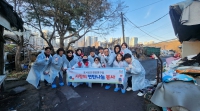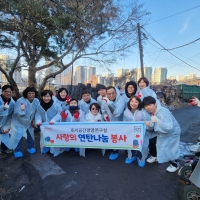
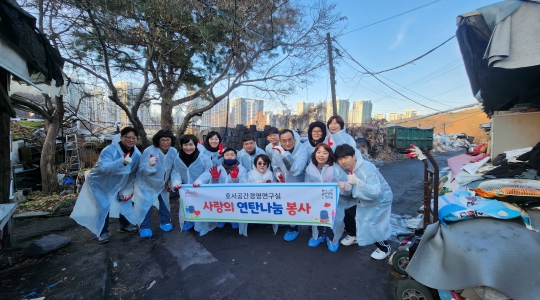
[Samuel Chung Koreanjournal Journalist ten@tenspace.co.kr] SEOUL — On a cold December morning, a group of graduate students and professors from Hoseo University walked narrow, winding paths through Guryong Village, stacking briquettes by hand for elderly residents who rely on them to survive the winter.
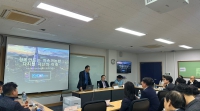
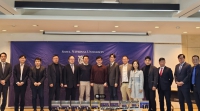
The visit, organized by the university’s Graduate School of Venture Studies and its Spatial Management Research Lab, replaced a traditional end-of-year ceremony. Instead of a banquet hall, the gathering took place in one of Seoul’s most marginalized neighborhoods — a reminder that not all parts of the global city share in its prosperity.
More than 20 participants, including current and former master’s and doctoral students, delivered 1,000 briquettes to energy-vulnerable households. For many residents, the briquettes remain a primary source of heat during winter months.
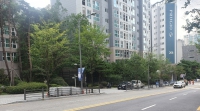
Guryong Village, tucked away in the affluent Gangnam district, emerged in the late 1980s as displaced families settled on unused land amid rapid urban development. Over decades, the settlement grew into what is often described as Seoul’s last large shantytown — a stark contrast to the high-rise apartments and glass towers nearby.
Though a large-scale redevelopment plan has now been approved, daily life in the village remains precarious. Aging infrastructure, steep alleys, and an elderly population have long raised concerns about safety and energy poverty, particularly during extreme weather.
“For students who study space, cities, and development, it’s important to confront the realities that exist beyond planning documents and investment maps,” said Professor Lee Jae-soon, who led the initiative. “We wanted to understand space not as an abstract concept, but as a lived environment.”
Professor Lee emphasized that urban value cannot be measured solely by land prices or architectural form. “A space becomes meaningful only when the lives within it are warm and dignified,” he said. “We hope this small act helps residents endure the winter, and reminds us of our responsibility as scholars.”
Participants described the experience as a lesson beyond the classroom. Carrying briquettes up steep slopes, they spoke with residents who have lived in the village for decades, many of whom expressed uncertainty about what redevelopment will bring.
Urban researchers note that Guryong Village reflects a broader challenge facing global cities: how to reconcile redevelopment with social continuity. While new housing may improve physical conditions, the transition period often leaves residents vulnerable.
By choosing Guryong Village as the site of its year-end gathering, the Hoseo University group sought to connect academic inquiry with civic engagement. The effort, organizers said, is part of a broader commitment to social contribution that extends beyond a single event.
As Seoul continues to remake itself, the quiet exchange of warmth in Guryong Village offered a different measure of progress — one defined not by skyline changes, but by human connection.